

2026/04/13
Share


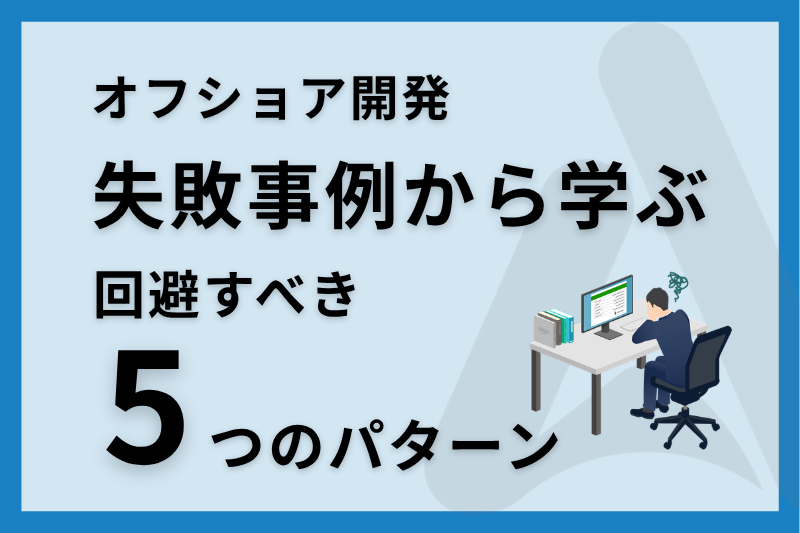
5 Common Offshore Development Failure Patterns and How to Avoid Them
目次
- Introduction
- Pattern 1: Going In with Vague Specifications
- Pattern 2: Failing to Design a Communication Structure
- Pattern 3: Choosing a Vendor on Price Alone
- Pattern 4: Handing Off Quality Control and Testing Entirely
- Pattern 5: Starting with a Large-Scale Order Right Away
- Conclusion: Failures Can Be Prevented with the Right Systems
Introduction
“The deliverable didn’t match the spec.” “We couldn’t track progress until the deadline was almost here.” “We had no idea how to verify quality before it was delivered.” — These are concerns we hear regularly from companies involved in offshore development.
We are no exception. Over many years of offshore development, we have faced similar challenges. In most cases, the root cause wasn’t “the inherent limitations of offshore development” — it was that neither the client nor the vendor had the right systems in place.
In this article, we categorize the most common failure patterns into five types and explain how to address each one. We hope it serves as a useful reference before you start your offshore engagement.
Pattern 1: Going In with Vague Specifications
One of the most common problems in offshore development is ambiguous requirements. “I explained it verbally.” “Please refer to the previous system.” “We’ll figure out the details as we go.” — These approaches may work to some degree in domestic development, but in offshore contexts they create critical misalignments.
Even in domestic projects, vague specs lead to rework. But when working with an overseas team, language, cultural, and business practice differences amplify the impact significantly. A single sentence in a spec document can be interpreted differently by Japanese and overseas teams alike — and when these “assumed-understood” items pile up, deadline delays and quality issues occur simultaneously.
We have experienced rework caused by misaligned spec interpretations in our own projects. Through that experience, we’ve come to understand just how critical documentation and upfront alignment truly are.
How to avoid it:
- Document screen specifications, business flow diagrams, and input/output definitions, and gain alignment before work begins
- Build spec review sessions into the design phase for two-way confirmation
- Mark ambiguous items as “TBD” explicitly, with a rule to update them once decided
Pattern 2: Failing to Design a Communication Structure
Even with a solid spec, problems accumulate when the communication framework isn’t in place during development. If you take a “contact us if anything comes up” approach and leave the team to their own devices, the development team will proceed while holding unresolved decisions — and you won’t discover the issues until the deliverable arrives.
Having multiple fragmented communication channels is also problematic. When some team members use Slack and others use email, information gets scattered. “I told someone” no longer means “the team was informed.”
At our company, the tools vary by client — Slack, Teams, Chatwork, Backlog — and we adapt flexibly to the client’s environment. But regardless of which tool is used, the premise is always to consolidate to a single channel and point of contact within the project. In fact, one long-term client told us that after establishing a structure of weekly Zoom check-ins, Backlog for progress tracking, and Slack for daily communication, they achieved “consistently high-quality development they could rely on.”
For the basics of communication design, see also: What is Offshore Development? Benefits, Drawbacks, and Keys to Success
How to avoid it:
- Schedule regular meetings: Make weekly progress check-ins mandatory — async alone isn’t enough
- Consolidate channels and contacts: Standardize communication channels within the project to prevent scattered information
- Standardize reporting formats: Use weekly reports to formalize issues, progress, and risks
- Agree on tools upfront: Adapt to the client’s tools while keeping a single channel within the project
Pattern 3: Choosing a Vendor on Price Alone
Selecting a vendor solely because their per-person-month rate is low is one of the highest-risk decisions you can make. The offshore development market includes a significant number of vendors that market their low costs while lacking adequate PM structure, quality management, and Japanese-language capability.
Even if cost reduction was the reason for going offshore, accumulated communication costs and rework costs can make the total comparable to — or higher than — domestic development. It’s essential to evaluate vendor structure, track record, and management systems as a package, not just the unit price.
5 key things to check when selecting a vendor:
- Communication structure: Is there a Japanese-speaking contact, or does the PM/interpreter have sufficient Japanese capability?
- Quality management: Are QMS standards and code review processes in place?
- Specificity of track record: Can they show experience with projects similar in industry, scale, and tech stack?
- Reporting structure: Is their weekly reporting and issue management system standardized?
- Security posture: Do they have ISMS certification? What are their rules for handling confidential information?
Pattern 4: Handing Off Quality Control and Testing Entirely
“The vendor will handle testing, so we’re fine” is a dangerous assumption. If the development side and the client side haven’t aligned on what “passing” means, the vendor may report tests as complete while the deliverable falls short of the client’s quality expectations.
This can happen in domestic development too, but with an overseas team, it’s harder to establish shared standards for “what constitutes completion” — which raises the risk. Leaving test design responsibilities undefined can cause problems to surface just before a production release.
At our company, we include all phases from basic design through unit and integration testing within our scope, and our PMs clarify and manage who is responsible for each phase.
How to avoid it:
- Agree on test phase scope and responsibility allocation before signing the contract
- Clearly define the acceptance criteria for test completion upfront
- Explicitly state in the contract that test specifications and evidence must be included in the deliverables
Pattern 5: Starting with a Large-Scale Order Right Away
Placing a large order of tens of person-months on your very first offshore engagement is high-risk. Vendor compatibility, communication quality, and actual technical capability can only be properly assessed by actually working through a project together.
We recommend new clients start with a trial to evaluate cost and quality. Looking at our own track record, 728 out of 800+ projects have been under 10 person-months. It’s realistic to start with a small fixed-price project, verify structure, quality, and communication, and then gradually expand the scale and number of engagements.
Starting immediately with a lab-style (time-and-materials) contract is not suited for small starts — when team design and shared business understanding aren’t yet established, misaligned expectations arise on both sides. The better path is to build the relationship through a clearly scoped fixed-price engagement first, then consider ongoing collaboration.
How to avoid it:
- Start your first engagement as a small fixed-price project
- Verify quality, communication, and compatibility before scaling up
- Consider transitioning to a lab-style model only after trust has been established
Conclusion: Failures Can Be Prevented with the Right Systems
Looking back at the five patterns, while technical capability plays a role, the biggest root cause is consistently “the absence of proper systems.”
| Failure Pattern | Root Cause | Core Solution |
|---|---|---|
| Vague specifications | Over-reliance on tacit knowledge | Documentation and alignment processes |
| Communication failures | No structure or point of contact | Regular meetings, unified tools and contacts |
| Wrong vendor selection | Deciding on price alone | Evaluate structure, quality, and track record |
| Outsourced quality management | Unclear completion criteria | Agree on test phase scope |
| Large initial order | Over-trusting without a track record | Start with a small fixed-price project |
We too have continuously refined our approach to offshore development through trial and error. The insights in this article are drawn from that experience. Whether you’re considering offshore development for the first time, or have had setbacks in the past, start by reviewing your own ordering process, communication design, and vendor selection criteria.
Frequently Asked Questions
Q. What is the very first thing we should do to prevent offshore development from failing?
Document your requirements and reach agreement on them before the project starts. Approaches such as “we explained it verbally” or “just refer to our previous system” do not reliably convey intent to an overseas team, given differences in language, culture, and business practices. The starting point is to prepare screen specifications, business flow diagrams, and input/output definitions, then confirm them with both sides before kicking off the project.
Q. If communication is not going well, where should we start improving it?
Start by setting up a regular meeting at least once a week and establishing a standard format for sharing progress and issues. Simply consolidating your points of contact and communication tools can greatly reduce the scattering of information. The top priority is building a structure that allows problems to be identified and addressed early.
Q. Is it fine to leave quality control entirely to the vendor?
No. Both sides need to agree, before the contract begins, on the acceptance criteria that define when testing is considered complete. It is not unusual for a vendor to report that “testing is complete” when the actual quality still falls short of what the client expects. Make sure the contract explicitly requires test specifications and supporting evidence to be included as deliverables.
Q. What is the one thing we should absolutely avoid when starting offshore development for the first time?
Avoid placing a large-scale order right from the start. You cannot know how well you will work with a vendor, the quality of communication, or their actual technical capability until you have actually run a project with them. It is safer to begin with a contract-based project of around one to three person-months, confirm the team’s structure and quality, and then scale up from there.
Q. Should we start with lab-type development or contract-based development?
For a first engagement, we recommend starting with contract-based development. Lab-type development is prone to misalignment when team structure and shared understanding of the business are not yet well established, making it less suitable for a small, cautious start. It is more realistic to shift to a lab-type model once a relationship of trust has been built.
Q. What is the most important point when selecting a vendor?
The communication structure and the concreteness of their track record. If you choose based on price alone, the hidden costs of communication and quality management can accumulate over time, sometimes making the total cost higher than domestic development. Be sure to check the PM structure, Japanese-language support capability, and quality management process together, as a set.
We will propose the best approach for your project
As a leading Japanese IT solutions company with approximately 20 years of experience in Vietnam offshore development, we provide software and system development services.
Please feel free to contact us when considering offshore development.
Vietnam Offshore DevelopmentCase Studies | Download Materials | Free Consultation | Contact via LINE

Author
Kensuke Yodoki
Digital marketing and offshore development consultant with over eight years of hands-on experience spanning gaming media, e-commerce, and manufacturing. After building expertise in SEO and content strategy at a Japanese venture firm, he moved to Vietnam in 2020 to lead the establishment of an in-house web department for a manufacturing company—from scratch. Since joining ALLEXCEED VIETNAM in 2024 as a consultant, he has been working on the front lines of offshore development projects. Having navigated offshore development from both the client and execution sides, he writes about the realities that never make it into vendor brochures.

Reviewed by
Steven Ng
Offshore development strategist and IT project management expert with a track record spanning 100+ delivered software and web applications. A multilingual professional, he brings a uniquely cross-cultural perspective to every engagement. After gaining broad business experience at an IT startup from 2015, he relocated to Vietnam and managed 50+ projects as PMO/PM/PdM at an offshore development firm. In 2019, he founded LLL ASIA, a software development company, serving as CEO. He joined ALLEXCEED VIETNAM in 2024, overseeing business development, consulting, and the sales and marketing organization. A leading authority in Vietnam's offshore development industry, with a career spanning entrepreneur, project manager, and C-suite executive.

Category
Most Popular Articles
![[Expert Guide] Best Languages for Business System Development: Java vs C# vs VB.NET vs PHP](https://allexceed.com.vn/wp/wp-content/uploads/2026/01/89be2c7b401ea2aeda420a10586ae6a6.jpg)
![[DX Strategy] VB6 Migration Guide: VB.NET vs. C# vs. SaaS – Making the Optimal Choice](https://allexceed.com.vn/wp/wp-content/uploads/2026/01/89be2c7b401ea2aeda420a10586ae6a6-1.jpg)




Load More
Related column
Related column
OFFSHORE
Offshore Development Services by
ALLEXCEED VIETNAM
ALLEXCEED VIETNAM is a Japan-invested IT solutions company with over 20 years of development experience in Vietnam, specializing in software and system development services.
We offer high-quality offshore development services through our "Offshore Development 2.0" model—an enhanced approach built upon traditional offshore development methods.
-

- Column
- Offshore Development
- 5 Common Offshore Development Failure Patterns and How to Avoid Them
