

2025/09/15
Share


Comparing SES and Offshore Lab-Style Development | Which Is the Best Fit for Your Company?
目次
As solutions to the domestic engineer shortage and rising labor costs, “SES (System Engineering Services)” and offshore “Lab-Style Development” are gaining attention.
This column organizes the differences between the two from the perspectives of contract structure, team composition, cost, communication, and knowledge accumulation, and provides concrete guidance on which approach suits which scenario.
It also covers legal considerations (quasi-delegation contracts and disguised dispatching), monthly unit cost benchmarks, and the role of BrSE (Bridge SE), offering information to support your decision-making.
Positioning of Domestic SES and Offshore Lab-Style Development
In Japan’s IT industry, the engineer shortage and rising labor costs have become structural challenges.
As solutions to these issues, two approaches are widely considered:
① “SES (System Engineering Services),” which leverages domestic external resources
② “Lab-Style Development” in offshore development, which utilizes overseas teams
For more on offshore development, see Vietnam Offshore Development
Both approaches involve “utilizing external resources,” but they differ significantly in terms of development structure and operations.
Whether to use SES or Lab-Style Development for your projects—this column will clarify the advantages and disadvantages of each, and present which scenarios each approach is best suited for.
Understanding the Basics of SES and Lab-Style Development
Before comparing SES and Lab-Style Development, let’s first summarize the fundamental information about each.
What Is SES (System Engineering Services)?
SES is a model where engineers are dispatched from an SES provider and engineering services are delivered on a time-based basis.
Engineers typically work on-site at the client company’s office and perform development there.
SES engineers and their vendor companies do not bear quality responsibility for deliverables. It is a quasi-delegation contract where “labor provision” is the service rendered by the vendor, and compensation is based on time × unit rate.
There is generally no obligation to complete deliverables; payment is made for the performance of work itself. Additionally, direct command and supervision of individual engineers by the client company is not expected.
If the client company gives direct instructions to SES engineers, it may be deemed “disguised dispatching” and could become subject to administrative guidance, so caution is required.
What Is Lab-Style Development?
Lab-Style Development is a contract model in offshore development where a dedicated team of a fixed number of members is secured for a fixed period to carry out development.
It is well suited for medium- to long-term feature expansion, and its key characteristic is that knowledge is easily accumulated within the team.
Vendor teams include not only development engineers but also bridge engineers who support communication, facilitating interaction with clients.
About Contract Development
In offshore development, the counterpart to Lab-Style Development is “Contract Development.”
Contract Development is a contract model based on deliverable units, with emphasis on delivering the product within defined requirements and deadlines.The choice between the two depends on the specifications and requirements:
・When specifications are firmly defined → Contract Development
・When detailed specifications are not yet determined and you want to develop iteratively → Lab-Style Development
Commonalities Between SES and Lab-Style Development
SES and Lab-Style Development are often compared because they share many commonalities. Let’s summarize their shared characteristics here.
Contract Structure
Both SES and Lab-Style Development use the quasi-delegation contract model, meaning compensation is paid for engineers’ work performance rather than for completing deliverables.
The vendor fulfills the contract by providing engineers and having them work.
Cost Calculation Method
Since the contract is for labor provision, costs are calculated as time × engineer unit rate.
While this makes cost forecasting easier, there is also a risk of costs ballooning depending on management.
Flexible Staffing Adjustments
Because costs are calculated on a man-hour basis, staffing adjustments are relatively easy. However, the lead time for adjustments differs between the two approaches (discussed later).
Project Management on the Client Side
As quasi-delegation contracts, outcomes are significantly influenced by how well the client manages the project—including requirements definition, priority allocation, and clarification of acceptance criteria.
Differences Between SES and Lab-Style Development
Having covered the commonalities, let’s now summarize the differences between the two.
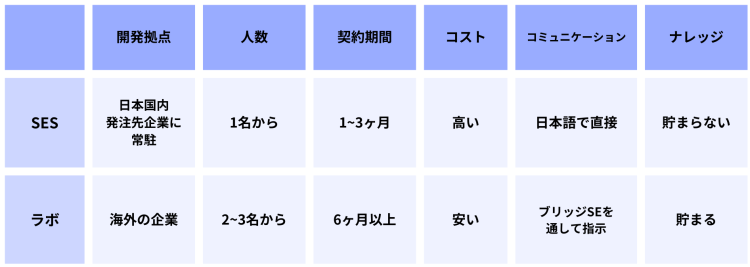
Location and Team Composition
SES:
Development takes place domestically in Japan. Engineers typically work on-site at the client company.
A PM may be assigned by the SES provider, but their role primarily focuses on resource management and task management for engineers within their own company, as well as quality checks—project management itself is generally out of scope.
Lab-Style Development:
A team based at an overseas location such as Vietnam or India handles development.
Between the client and the development company, there are Japanese PMs, Bridge SEs, and IT communicators (interpreters specializing in system development), enabling communication entirely in Japanese.
Team Structure and Contract Duration
SES:
Contracts can start from a minimum of 1 person, with short-term engagements (1–3 months) easily arranged, making it strong for spot demand.
Lab-Style Development:
A minimum of 2–3 members is required, with contracts typically starting from at least 6 months.
It pairs well with ongoing modifications and long-term development.
Cost
SES:
Rates vary by role, skill level, and location, but the standard floor is at least ¥600,000/month.
Lab-Style Development:
Rates vary by country, but in Vietnam, for example, they start from around ¥300,000/month.
While rates fluctuate depending on the vendor and requirements, costs are generally one-third to one-half compared to SES.
What About Quality?
When you hear about lower costs, quality naturally becomes a concern.
While there are differences by country and company, quality comparable to domestic standards can be achieved.
Among the many reasons, one example is that countries like India and Vietnam invest in IT education as national policy, producing a large number of highly skilled engineers.
To become an engineer, one must receive engineering education at university and graduate. This environment naturally cultivates a strong base of knowledgeable, skilled engineers.Reference: Why System Development in Vietnam?
Staffing Flexibility
While both allow staffing adjustments, they differ considerably in lead time flexibility.
SES:
Strong at rapid response—such as adding one person from next week.
Lab-Style Development:
Strong at medium- to long-term scaling.
Immediate response (e.g., next week) is difficult, but it offers greater flexibility for scaling up/down and role adjustments in the context of ongoing long-term development.
Communication
SES:
Development in the same language and same location makes communication and status sharing relatively straightforward.
Lab-Style Development:
Bridge SEs fluent in both Japanese and Vietnamese, along with Japanese PMs, serve as intermediaries for communication with engineers.
*The client company can communicate entirely in Japanese.
Knowledge Accumulation
SES:
Since individuals join projects independently, knowledge tends to become person-dependent, making it difficult to accumulate organizational knowledge.
Lab-Style Development:
Because the team operates continuously, product knowledge accumulates effectively. The longer the engagement, the greater the improvement in productivity and speed.
The Philosophical Difference Between SES and Lab-Style Development
Summarizing the differences above, we can say the following:
SES supplements domestic resources on a short-term, spot basis for development.
Lab-Style Development builds a dedicated team overseas for medium- to long-term development.
Ideal Use Cases for Each Approach
Based on the differences outlined above, let’s look at what types of development projects each approach is best suited for.
Cases Where SES Is the Better Fit
The strengths of SES lie in its rapid response capability and suitability for localized support.
It is ideal when you need to reinforce staff during peak periods or for specific phases of development.
Specific examples:
① Spot staffing for incident response or peak periods (1–3 months)
② Short-term staffing reinforcement for specific development phases
etc.
Cases Where Lab-Style Development Is the Better Fit
Since Lab-Style Development involves a dedicated team working continuously, it excels in scenarios that benefit from accumulated productivity and knowledge over time.
It is well suited for long-term development of proprietary services, or when ongoing maintenance including modifications and continued development is expected after system completion.
Specific examples:
① Cases where you want to develop and grow a product over the medium to long term
② Cases where domestic hiring is difficult but you want to secure a stable team
etc.
Summary | SES for Spot Needs and Lab-Style Development for Medium- to Long-Term Vision
This article explained the characteristics of each approach and the scenarios they are best suited for.
Both are similar in that they provide “man-hour-based resources,” but they differ in their time horizons and philosophies toward team building.
SES is agile for short-term gap-filling, while Lab-Style Development is a better fit for product growth, knowledge accumulation, and total cost optimization.
By strategically combining both approaches according to your development phase, you can drive system development—and ultimately, business growth.
Frequently Asked Questions
Q. What is the biggest difference between SES and lab-based development?
The fundamental concept behind each model is different. SES is designed for short-term, ad hoc resource augmentation within the domestic market, while lab-based development is designed to build a dedicated offshore team over the medium to long term. Think of it as the difference between “temporarily borrowing personnel” and “continuously developing a team.”
Q. Which model is more cost-effective?
Lab-based development is generally more cost-effective. In Vietnam, the starting rate is approximately 300,000 JPY per month, roughly one-third to half the cost of domestic SES (which typically starts at around 600,000 JPY per month). That said, lab-based development typically requires a minimum contract period of six months, so SES offers greater flexibility for strictly short-term needs.
Q. Do SES and lab-based development use different contract structures?
The underlying structure is essentially the same — both use a mandate contract (jun-inin keiyaku). Neither model carries an obligation to deliver a specific end product; instead, both bill on a time-and-unit-rate basis in exchange for the execution of defined work. As a result, project management responsibilities remain with the client under both arrangements.
Q. What is the minimum team size and contract duration to start with lab-based development?
A team of two to three engineers is the typical minimum, with a contract period of at least six months as a general guideline. Securing a consistent team over a sustained period allows knowledge and expertise to accumulate within the team, improving productivity in ongoing development work.
Q. Which model is better suited when I need to scale up engineers for a short period?
SES is the better fit. It supports flexible, short-term engagements starting from a single engineer, with contract durations as brief as one to three months — making it well-suited for urgent needs such as “we need to ramp up next week.” SES’s agility is particularly valuable for incident response and peak-period resource augmentation.
Q. What is “disguised contracting” (illegal worker dispatch), and should I be concerned about it?
Disguised contracting refers to a situation in which the client directly issues instructions to engineers under a contract type that does not legally permit such direction — a practice that constitutes a violation of labor regulations. Because both SES and lab-based development operate under mandate contracts, it is essential to understand and correctly apply the boundaries of the client’s authority to direct work.
Q. Once I sign a lab-based development contract, can I simply hand everything off?
No. Because lab-based development operates under a mandate contract, responsibilities such as defining requirements and overseeing progress remain with the client. A bridge SE supports day-to-day communication, but the responsibility for clarifying “what you want to build” always rests with the client.
Q. Does offshore lab-based development deliver lower quality than domestic SES?
Not necessarily. Countries such as Vietnam and India have invested heavily in IT education as a national priority, resulting in well-developed university-level engineering pipelines. With the right team composition and code review processes in place, quality comparable to domestic development is entirely achievable. For a broader overview of offshore development — the foundation on which lab-based development is built — see “What Is Offshore Development? Benefits, Drawbacks, and Keys to Success.”
We will propose the method that fits your project
As a leading Japanese IT solution company with approximately 20 years of experience in Vietnam offshore development, we have been providing software and system development services. Please feel free to consult us when considering offshore development.

Author
Kensuke Yodoki
Digital marketing and offshore development consultant with over eight years of hands-on experience spanning gaming media, e-commerce, and manufacturing. After building expertise in SEO and content strategy at a Japanese venture firm, he moved to Vietnam in 2020 to lead the establishment of an in-house web department for a manufacturing company—from scratch. Since joining ALLEXCEED VIETNAM in 2024 as a consultant, he has been working on the front lines of offshore development projects. Having navigated offshore development from both the client and execution sides, he writes about the realities that never make it into vendor brochures.

Reviewed by
Steven Ng
Offshore development strategist and IT project management expert with a track record spanning 100+ delivered software and web applications. A multilingual professional, he brings a uniquely cross-cultural perspective to every engagement. After gaining broad business experience at an IT startup from 2015, he relocated to Vietnam and managed 50+ projects as PMO/PM/PdM at an offshore development firm. In 2019, he founded LLL ASIA, a software development company, serving as CEO. He joined ALLEXCEED VIETNAM in 2024, overseeing business development, consulting, and the sales and marketing organization. A leading authority in Vietnam's offshore development industry, with a career spanning entrepreneur, project manager, and C-suite executive.

Category
Most Popular Articles
![[Expert Guide] Best Languages for Business System Development: Java vs C# vs VB.NET vs PHP](https://allexceed.com.vn/wp/wp-content/uploads/2026/01/89be2c7b401ea2aeda420a10586ae6a6.jpg)
![[DX Strategy] VB6 Migration Guide: VB.NET vs. C# vs. SaaS – Making the Optimal Choice](https://allexceed.com.vn/wp/wp-content/uploads/2026/01/89be2c7b401ea2aeda420a10586ae6a6-1.jpg)
Load More
Related column
Related column
OFFSHORE
Offshore Development Services by
ALLEXCEED VIETNAM
ALLEXCEED VIETNAM is a Japan-invested IT solutions company with over 20 years of development experience in Vietnam, specializing in software and system development services.
We offer high-quality offshore development services through our "Offshore Development 2.0" model—an enhanced approach built upon traditional offshore development methods.
-

- Column
- Offshore Development
- Comparing SES and Offshore Lab-Style Development | Which Is the Best Fit for Your Company?
